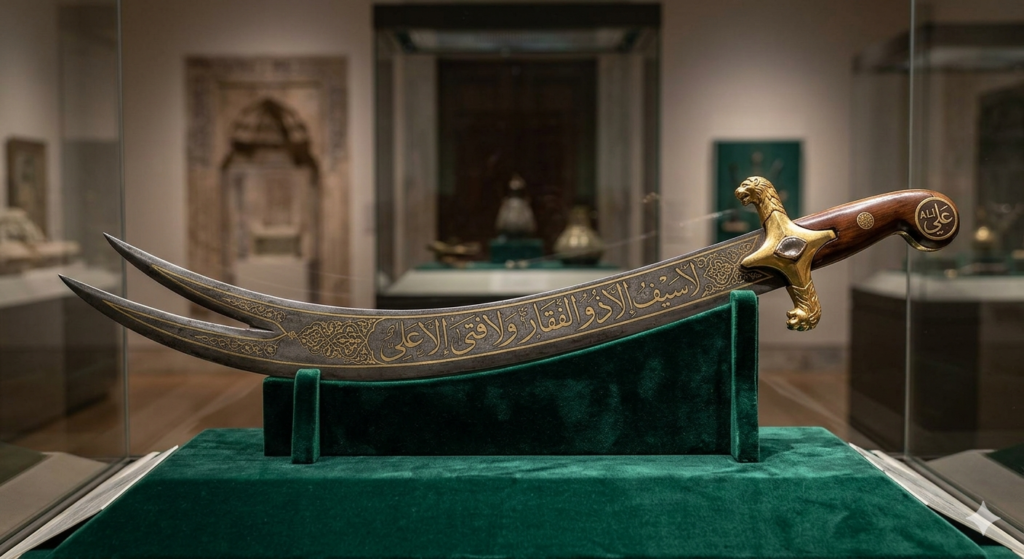
Zulfiqar: The Blade of Legend and Legacy
The word “Zulfiqar” (Arabic: ذُو ٱلْفَقَار, romanized: Dhū l-Faqār) resonates with power and prestige across the Islamic world. It is the name of the legendary sword wielded by Hazrat Ali ibn Abi Talib, the cousin and son-in-law of Prophet Muhammad (peace be upon him), and the first Imam in Shi’a Islam. More than just a weapon, the Zulfiqar has evolved into a potent symbol of courage, justice, divine favor, and the enduring legacy of the Prophet’s family (Ahl al-Bayt). This article explores the rich tapestry of history, legend, and symbolism surrounding this iconic blade.
Etymology and Physical Depictions
The precise etymology of “Zulfiqar” is a subject of scholarly debate, although most interpretations center around its unique physical characteristics. The name is commonly understood to mean “Possessor of the Vertebrae” or “Spine-Splitter.” This may refer to:
Decorative Notches: Some theories suggest the sword was known for distinctive notches or indents along its spine, resembling vertebrae.

Its Deadly Precision: The name might allude to its terrifying efficiency in battle, capable of cleaving through armor and the spines of opponents.
The Forged Structure: Another interpretation suggests the name relates to the layered pattern welding often seen in high-quality damascus steel, which might have resembled spinal segments.
Regardless of the exact origin of its name, the most striking and iconic feature associated with the Zulfiqar in popular and artistic imagination is its bifurcated (forked) tip.
While historical reality concerning the sword’s exact form is difficult to verify (most of the earliest examples of curved Middle Eastern swords, or scimitars, date from later centuries), the dual points became its defining visual characteristic in Islamic art, calligraphy, and literature. This double-pointed blade is often interpreted symbolically, representing concepts such as:
Divine Dualities: The balance between knowledge and faith, or the external (exoteric) and internal (esoteric) dimensions of religious understanding.
Justice and Authority: The power to distinguish between truth and falsehood.
The Attributes of Ali: Representing his unparalleled bravery on one hand and his deep wisdom and mercy on the other.
Historical Origins: The Prophet’s Gift
The origin story of the Zulfiqar is deeply intertwined with the early history of Islam and the battlefield exploits of Hazrat Ali. While there are different traditions regarding how it first appeared, the most prevalent and widely accepted account places its acquisition during the momentous Battle of Uhud (625 CE).
The Battle of Uhud
Uhud was a pivotal early conflict between the Muslim community in Medina and the Quraysh tribe of Mecca. During the chaotic retreat of the Muslim forces, Hazrat Ali displayed extraordinary bravery and skill, defending Prophet Muhammad against repeated attacks.
In the midst of this desperate fight, several of Ali’s own swords were said to have shattered. According to many historical accounts and hadith traditions, it was at this moment that Prophet Muhammad handed Ali his own personal sword—the Zulfiqar.
Some traditions emphasize the divine nature of the gift, recounting that the Archangel Jibril (Gabriel) descended and declared, after observing Ali’s unmatched heroism:
لَا سَيْفَ إِلَّا ذُو ٱلْفَقَارِ وَلَا فَتَىٰ إِلَّا عَلِيٌّ (Lā sayfa illā Dhū l-Faqāri wa-lā fatā illā ʿAlīyun) “There is no sword but the Zulfiqar, and there is no Hero but Ali.”
This powerful declaration solidified the bond between the warrior and the blade, elevating both to legendary status. The Zulfiqar became inseparable from Hazrat Ali, the symbol of his unmatched prowess and devotion.
The Blade of Hazrat Ali: Symbolism in Action
In the hands of Hazrat Ali, the Zulfiqar became synonymous with victorious justice. He wielded it in every major conflict of early Islam—including the Battle of the Trench, the Conquest of Khaybar, and later battles during his caliphate.
Symbol of Justice and Compassion
Despite its deadly purpose, the Zulfiqar—when paired with Ali—also came to symbolize justice and ethical conduct in warfare. Hazrat Ali was known for strict adherence to Islamic ethics, refusing to kill a defeated opponent or strike from behind. Stories are told of his mercy on the battlefield, where he used his strength not just to conquer but to establish fairness.

The two points of the blade are sometimes interpreted as the scales of justice, ensuring balance and equity. The hilt is seen as representing firm leadership and governance rooted in faith.
A Sign of Leadership and Succession
For the Shi’a community, the Zulfiqar holds particular significance as a tangible sign of the Imamate—the divine leadership of the Ahl al-Bayt. By presenting Ali with this sword, Prophet Muhammad was seen not only as recognizing his bravery but also as signaling his unique role as the closest companion and rightful spiritual and political successor (according to Shi’a belief).
The sword became one of the key insignia passed down from Imam to Imam, representing the authority and responsibilities of the office.
Zulfiqar in Islamic Art, Calligraphy, and Culture
Over the centuries, the Zulfiqar has transcended its origins as a physical object to become one of the most powerful and recognized icons in Islamic visual and material culture.
Calligraphy and the Shape of Faith
One of the most striking uses of the Zulfiqar is in Islamic calligraphy. Artists developed a unique genre known as sword calligraphy, where the very shape of the blade is used as the canvas for sacred text.
The famous La Fata illa Ali declaration is perhaps the most frequent phrase integrated into these designs. The curves of the blade, the crossguard, and the distinctive forked tip are cleverly utilized to write the name of Ali (علي), the names of Allah, or entire verses from the Quran. This intertwining of calligraphic art and military imagery visualizes the concept of Jihad in its highest sense—the spiritual struggle against falsehood.
Weaponry and Heraldry
The Zulfiqar became a common motif in Islamic heraldry, appearing on banners, flags, shields, and the architecture of gates and palaces. It symbolized strength, protection, and the ruling dynasty’s claim to legitimacy and divine favor.
Many later Muslim military leaders, aiming to evoke the legendary strength and piety of Hazrat Ali, commissioned swords with forked tips or had the La Fata phrase inscribed upon their blades. The Ottomans, Safavids, and Mughals all incorporated Zulfiqar imagery into their military and state art.
Literary Legacy
Zulfiqar has made countless appearances in classical Arabic, Persian, Turkish, and Urdu literature. It is often personified, described as a companion to Ali, capable of roaring like a lion or speaking truths. Poets have used the blade as a metaphor for divine retribution, the split between truth and falsehood, and the devastating power of true faith.
In Persian and Urdu Marthiya (elegiac poetry commemorating the tragedy of Karbala), the Zulfiqar features prominently as the ultimate weapon of Imam Hussain, though often focused on the moment he had to lay it aside to achieve spiritual victory through martyrdom.
Modern Resonance
Today, the Zulfiqar remains a vibrant and potent symbol, particularly for Shi’a Muslims around the world.
It is a key visual during Muharram commemorations, symbolizing the spirit of resistance against tyranny. It is also a popular motif for personal jewelry, pendants, and home decor, serving as a reminder of the virtues of Hazrat Ali—courage, piety, and commitment to justice.
Its influence extends into the modern sphere, often seen on official emblems and medals. For example, the highest military honor of Iran is named the Order of Zulfiqar.
Conclusion
The story of the Zulfiqar is more than a simple account of a legendary weapon. It is the story of early Islam, the character of Hazrat Ali ibn Abi Talib, and the deep-seated spiritual and political legacy of the Prophet’s family.
Whether seen as a historical weapon, a divine gift, or a masterpiece of calligraphic art, the Zulfiqar remains a powerful testament to the enduring human ideals of justice and courage, forever splitting the darkness of falsehood with the light of divine truth. Its echo in the famous declaration—”No sword but the Zulfiqar, and no Hero but Ali”—continues to inspire millions across generations.


Hi, I’m ALI CHAUDHARY, the creator of Isoar. I started this platform out of my passion for technology and my curiosity to explore how it shapes our everyday lives. I love researching new tools, writing about emerging tech trends, and sharing practical tips that help people stay ahead in the digital age. Through Isoar, I aim to make technology accessible, useful, and exciting for everyone.